The Longest-Running Evolution Experiment #RwOT #Rwanda #Cristiano Ronaldo

The Longest-Running Evolution Experiment

????

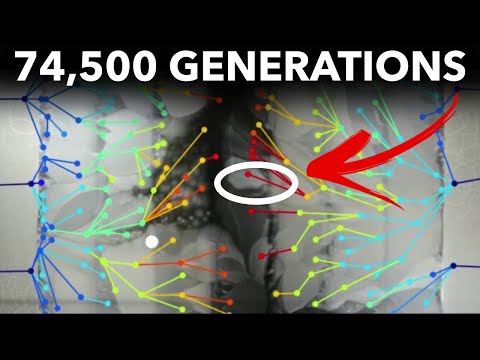
If you ran evolution all over again, would you get humans? How repeatable is #evolution? This video is sponsored by @BountyBrand. #biology #science #QPU #HygieneBeginswithBounty #BountyPartner Special thanks to Prof. Richard Lenski and team for showing me around the lab — it is an honor to be able to witness and document such a historic science experiment. Thanks to Dr Zachary Blount for the help with research and setting up the competition time-lapse, Dr Nkrumah Grant for microscope images of the long-term line cells @NkrumahGrant Devin Lake, Kate Bellgowan, and Dr. Minako Izutsu for being part of this video. Long Live the LTEE! LTEE website — http://myxo.css.msu.edu/ecoli/index.html Intro footage courtesy of the Kishony Lab — https://kishony.technion.ac.il ?????????????????????????? References: Lenski, R. E., & Travisano, M. (1994). Dynamics of adaptation and diversification: a 10,000-generation experiment with bacterial populations. Proceedings of the National Academy of Sciences, 91(15), 6808-6814. — https://ve42.co/Lenski1994 Lenski, R. E., Rose, M. R., Simpson, S. C., & Tadler, S. C. (1991). Long-term experimental evolution in Escherichia coli. I. Adaptation and divergence during 2,000 generations. The American Naturalist, 138(6), 1315-1341. — https://ve42.co/Lenski1991 Good, B. H., McDonald, M. J., Barrick, J. E., Lenski, R. E., & Desai, M. M. (2017). The dynamics of molecular evolution over 60,000 generations. Nature, 551(7678), 45-50. — https://ve42.co/Good2017 Blount, Z. D., Borland, C. Z., & Lenski, R. E. (2008). Historical contingency and the evolution of a key innovation in an experimental population of Escherichia coli. Proceedings of the National Academy of Sciences, 105(23), 7899-7906. — https://ve42.co/Blount2008 Blount, Z. D., Lenski, R. E., & Losos, J. B. (2018). Contingency and determinism in evolution: Replaying life's tape. Science, 362(6415). — https://ve42.co/Blount2018 Wiser, M. J., Ribeck, N., & Lenski, R. E. (2013). Long-term dynamics of adaptation in asexual populations. Science, 342(6164), 1364-1367. — https://ve42.co/Wiser2013 N, Scharping. (2019). How a 30-Year Experiment Has Fundamentally Changed Our View of How Evolution Works. Discover — https://ve42.co/Scharping ?????????????????????????? Special thanks to Patreon supporters: Mike Tung, Evgeny Skvortsov, Meekay, Ismail Öncü Usta, Paul Peijzel, Crated Comments, Anna, Mac Malkawi, Michael Schneider, Oleksii Leonov, Jim Osmun, Tyson McDowell, Ludovic Robillard, Jim buckmaster, fanime96, Juan Benet, Ruslan Khroma, Robert Blum, Richard Sundvall, Lee Redden, Vincent, Marinus Kuivenhoven, Alfred Wallace, Arjun Chakroborty, Joar Wandborg, Clayton Greenwell, Pindex, Michael Krugman, Cy 'kkm' K'Nelson, Sam Lutfi, Ron Neal ?????????????????????????? Research and Writing by by Derek Muller, Petr Lebedev and Casey Rentz Animation by Iván Tello Filmed by Derek Muller, Emily Zhang and Raquel Nuno Edited by Derek Muller Music by Jonny Hyman and from Epidemic Sound https://epidemicsound.com Additional video supplied by Getty Images Thumbnail image courtesy of the Kishony Lab Produced by Casey Rentz ??????????????????????????

Advertisement

LEAVE YOUR COMMENT

LATEST COMMENTS

@حامل.المسك96026 Says:
‏‪2:03‬‏ COME ON
@kenneths.9315 Says:
Wow bacteria changed into bacteria. Evolution at its finest.
@JohnCarboni-f6n Says:
74,500 generations of bacteria evolving into BACTERIA. Imagine that many generations of humans evolving, there would still be humans, ape theory debunked. Besides mutations are a loss of information, not beneficial for macro evolution.
@Alexandra-ob1pp Says:
I was like why is someone allowing a bacteria to do this, and it turns out it's my exact university 😭😭😭😭😭😭😭😭
@JohnoRFC96 Says:
6 7
@glockreaper2049 Says:
My favourite Veritasium video of all time
@content_wala2626 Says:
8:43 first rule of fight club - do not talk about fight club
@rickc4133 Says:
Or, with more simplicity, God just spoke the universe and life into existence. Easy - no waiting billions of years for inanimate material turning into life which is a combinatorial impossibility. God just said Go!
@AnkeetKumar Says:
I had tears in my eyes towards the end of the video! Science is amazing 💌
@malo6550 Says:
How about starting another run, except have the bacteria grow near a source of ionising radiation. Maybe set to a level that slows growth by 50%. This will do two things: 1. Creates an environment that will select for radiation resistance. 2. Significantly increase mutation rates.
@Gamamer Says:
god damn 67
@TheMichaelcollins Says:
Awesome
@mydogjustpoopedonmybed Says:
Now what are you gonna do if it escapes.....
@WadeDBurbankDC Says:
But the bacteria still remain bacteria.
@stellarfrosting Says:
a bit of bacteria on the counter is healthy, that way body learns to protect itself. you have to teach your immune system about the bacteria. and using only paper towel.. is that really so great for the environment? really?
@boxcar_billionaires Says:
33 years of being selected to find the tip of a pipette...
@lordchadthe69thofsussex72 Says:
six seven
@waynetshudy7954 Says:
So after that many generations, it is still e. Coli and still single-celled. I wonder if an original generation were compared to the latest generation in drastically different conditions, which would survive better. In other words, is the most recent generation only better in current conditions, or would the older generation be more robust in a widely ranging variety of conditions?
@islabonita4193 Says:
There it is . The universal answer 42...why is 42 the answer🤔
@asmakhaskeia7379 Says:
The E. coli long-term evolution experiment was designed to test a specific question: whether heritable genetic change alone is sufficient to produce evolutionary innovation under constant environmental conditions. The results suggest that it is indeed possible. Even in a relatively stable environment, new evolutionary traits eventually emerged. However, the experiment also shows that such innovations may require a very large number of generations before they appear. This is precisely where Denis Noble’s critique becomes relevant. Evolution in nature is characterized by variation and diversity. A design based on a largely constant environment can demonstrate that heredity is capable of generating evolutionary novelty, but it cannot evaluate how environmental differences might affect the speed at which such diversity emerges. In other words, the experiment shows that multiple evolutionary trajectories can arise within the same environment, indicating that internal genetic history matters. But it does not directly test another important hypothesis: whether different environments would accelerate or redirect the emergence of these differences. To properly assess the strength or weakness of environmental influence on evolutionary change, one would need to compare the same lineages evolving under different environmental conditions, rather than observing them only within a single stable environment. The experiment studies evolution in a single-cell system. Therefore it can show that heritable genetic change and evolutionary innovation can occur even under relatively constant environmental conditions. However, it does not test environmental influence at higher levels of biological organization, such as tissues or multicellular structure, because those levels simply do not exist in the organism being studied (E. coli).
@cptkirkp Says:
Mother Nature (The EARTH) will correct things. You have to look at earth as a living being. Look back to the "Great dying" postulated a super volcano spews billions of tons iof CO2 Into the atmosphere. Mother nature counteracts this with a bloom in critters in the ocean and the carbon is absorbed by the earth. The extinction was not complete so life carried on. Google the *White cliffs of Dover* - this is mother earths answer to the huge contaminent.
@crabkap-b6d Says:
3:40 why... just.. why
@yuushinichi Says:
The numbers 6 and 7 following each other appear way to often in this video
@ManulManulmeaw Says:
67
@caferrara Says:
And they are still exactly the same e-coli bacterium with an acquired tolerance. Adaptation within kind is not evolution--i.e., a change of body plan. This experiment actually DISPROVES evolution and demonstrates the fixity of species. Plus, the conditions are strictly limited in the lab in a way not seen in nature.
@gillapfi Says:
Started as a bacteria ended as a bacteria... adaptation not evolution
@AshishSharma-c8m6l Says:
67
@BladesofElysian Says:
Could this process evolve bacteria capable of eating oil spills?
@patobread Says:
3:41
@Ocean_Jack Says:
After 1.5 million bacteria years, the bacteria is still bacteria. Clear proof of macro-evolution.
@Dumb-Dino-29 Says:
6:35 🇷🇴Romania mentioned
@Dumb-Dino-29 Says:
67 😛 😛 😛 😛
@therandomverseofficial Says:
Two decades later: What do you mean, the bacteria evolved to eat through glass? Three decades later: What do you mean, the bacteria evolved to eat through buildings? Four decades later: What do you mean, the bacteria evolved to eat through flesh?
@pigeon_cheesburger Says:
3:40
@HarpSeal_sin Says:
L to person who said 67 in newest comments from when i looked
@bekyves Says:
Why are these scientists not wearing gloves 😮‍💨😮‍💨
@etrazin7735 Says:
4:56 segregation
@tHaH4x0r Says:
16:06 In practice, I suppsoe he is right. But seeing how the genome is limited in length, there are only a finite (although very large) number of permutations possible right? So by its very nature there would be an upper bound in an environment, and supposedly also some kind of 'super organism' that is the optimum for its environment, and that eventually all colonies are likely to result in with infinite time. I do wonder, when would that power law stop being applicable.
@ihrmlan Says:
67
@peterkang6677 Says:
definition of what doesn't kill you makes you stronger
@alejrandom6592 Says:
If a monkey will eventually type every book then this experiment will eventually make a bacteria that escapes the experiment
@alejrandom6592 Says:
5:25 42
@1.4142 Says:
I attended a talk by him today!
@EokaBeamer69 Says:
cooooool
@Handsome_dude Says:
67
@sophwolf3593 Says:
hearing 2:03 in 2026 made me shudder
@ricefieIds Says:
2:03
@dragonsbeat7812 Says:
"even in the absence of environmental change, there are so many opportunities of smaller and smaller magnitude to continue to make progress that in fact, progress probably would never stop even in a constant environment."( 15:48 ) that quote makes life a little easier, thank you.
@MisterEpsilon Says:
That intro single handedly disproves young earth creationists 'You cant view evolution on the macro scale, in a humans life' well it did in 11 days
@Adlai-p5g Says:
I thought he was refrinsins the meme but it was 4 years ago

More Science Videos