This video is sponsored by Brilliant. The first 200 people to sign up via https://brilliant.org/veritasium get 20% off a yearly subscription.
Special thanks to:
Bruce Sherwood, Ruth Chabay, Aaron Titus, and Steve Spicklemore
https://matterandinteractions.org
VPython simulation: http://tinyurl.com/SurfaceCharge
Richard Abbott from Caltech
Electrical Engineering YouTubers:
Electroboom: https://www.youtube.com/c/Electroboom
Alpha Phoenix: https://www.youtube.com/c/AlphaPhoenixChannel
eevblog: https://www.youtube.com/c/EevblogDave
Ben Watson: https://www.youtube.com/channel/UCgZUVIEtBnnBpFWJuxl_E5g
Big Clive: https://www.youtube.com/c/Bigclive
Z Y: https://www.youtube.com/user/ZongyiYang
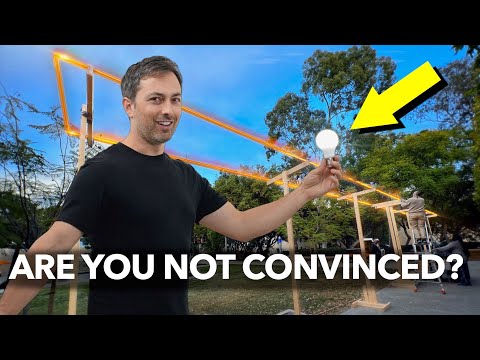
Further analysis of the large circuit is available here: https://ve42.co/bigcircuit
Special thanks to Dr Geraint Lewis for bringing up this question in the first place and discussing it with us. Check out his and Dr Chris Ferrie's new book here: https://ve42.co/Universe2021
???
References:
A great video about the Poynting vector by the Science Asylum: https://youtu.be/C7tQJ42nGno
Sefton, I. M. (2002). Understanding electricity and circuits: What the text books don't tell you. In Science Teachers' Workshop. -- https://ve42.co/Sefton
Feynman, R. P., Leighton, R. B., & Sands, M. (1965). The feynman lectures on physics; vol. Ii, chapter 27. American Journal of Physics, 33(9), 750-752. -- https://ve42.co/Feynman27
Hunt, B. J. (2005). The Maxwellians. Cornell University Press.
Müller, R. (2012). A semiquantitative treatment of surface charges in DC circuits. American Journal of Physics, 80(9), 782-788. -- https://ve42.co/Muller2012
Galili, I., & Goihbarg, E. (2005). Energy transfer in electrical circuits: A qualitative account. American journal of physics, 73(2), 141-144. -- https://ve42.co/Galili2004
Deno, D. W. (1976). Transmission line fields. IEEE Transactions on Power Apparatus and Systems, 95(5), 1600-1611. -- https://ve42.co/Deno76
???
Special thanks to Patreon supporters: Inconcision, Kelly Snook, TTST, Ross McCawley, Balkrishna Heroor, Chris LaClair, Avi Yashchin, John H. Austin, Jr., OnlineBookClub.org, Dmitry Kuzmichev, Matthew Gonzalez, Eric Sexton, john kiehl, Anton Ragin, Diffbot, Micah Mangione, MJP, Gnare, Dave Kircher, Burt Humburg, Blake Byers, Dumky, Evgeny Skvortsov, Meekay, Bill Linder, Paul Peijzel, Josh Hibschman, Mac Malkawi, Michael Schneider, jim buckmaster, Juan Benet, Ruslan Khroma, Robert Blum, Richard Sundvall, Lee Redden, Vincent, Stephen Wilcox, Marinus Kuivenhoven, Clayton Greenwell, Michael Krugman, Cy 'kkm' K'Nelson, Sam Lutfi, Ron Neal
???
Written by Derek Muller
Edited by Derek Muller
Filmed by Trenton Oliver and Petr Lebedev
Animation by Mike Radjabov and Ivy Tello
Additional video/photos supplied by Getty Images
Music from Epidemic Sound and Jonny Hyman
Produced by Derek Muller, Petr Lebedev, and Emily Zhang
A small bulb the hundreds of miles away from your 12v battery will not light. There is resistance on the wire, it will cause it not to light.
@KnowledgeHound25 Says:
“I guess they were thinking the bulb would only go on if the circuit were complete.”
Of course they were. At 0:20 you literally showed an image depicting exactly that scenario. Calling it a circuit in that state is misleading in the first place. It really feels like you were deliberately misled us in your original video.
@CorvusLvl20 Says:
4:26 phet mentioned
@machonsote918 Says:
So, it's really electric fields the ones that force electrons to do the work.
Let us say you have two batteries (A and B) of the same voltage and you attach one end of a copper wire to the positive terminal of battery A and the other end of the copper wire to a light bulb. You then use the end of another copper wire and attach it to the other side of the light bulb and the other end of the copper wire to the negative terminal of battery B.
Will the bulb light up?
@JohnTarsoly Says:
Great explainer. If only I knew what you were trying to explain. I've always thought current is sucked not pushed. That's the extent of my genius.
@reality-sheck Says:
Could you also explain the concept of a resistor instead of a bulb using this theory of yours. I want to see how the current in the circuit decreases because of the resistors
@jshanab42 Says:
so the switch near the bulb is important but a open switch at the end makes no difference. So what happens at then end of 1/c back to field equilibrium and everything stops. time to follow this up with what happens in the next second and to time domain signals
@WickedMoonGhostEntertainment Says:
It's a potential issue, quantum mechanics at it's best... the only reason why astrology seems feasible.
P.S.- you say that it describes the field in thre dimensions but the representation is two dimensional... I'm really tired of physics explaining a "four dimensional" universe in two dimensions...
@AndreeaCe Says:
Ummm...are we sure we're producing electricity as in being added to the already Universe's electricity or...are we stealing it -_-?
For example, this way of saying it "you're stealing my light", aren't some people overdue on this planet and are stealing light, energy of someone else's? And they aren't putting it in good use at all...
Why isn't the torpedo fish going around killing everything in the water? Why isn't the electric eel doing the same? They didn't go around killing everyone and everything, they don't go around murdering.
In some cases is good diverting but in much more cases is not.
@mirinoa4808 Says:
So humble, even having done nothing wrong u even went so far as to uplift ur critics
@soberTrezviy Says:
12:30 you are showing a literal parasitic capacitance at work, it's currents should be tiny compared to the stable work of this circuit
13:28 it will experience NO electric field if the circuit was open, because no difference on the switch
22:22 you made an outgareous claim, that's why people reacted. not because 100% of the video was wrong. the fault is *not* bad explaination. it's Substitution of concepts: making a claim about transmission of energy from source to consumer and then prove it like it was about induction. You can use comb on your heair and it will create *some* electric field which can light some tiny bulb (totally unrelated to original problem and proves nothing)
@ryandupuis5860 Says:
9th semester of EE, finally understand it
@miguel-fy7xi Says:
sorry can someone please explain why the surface charges modify and why the electric field inside the wires is no longer 0 because of the switch closing at 11:01
@JoeGator23 Says:
Veritasium's arrogance and reliance on outside helpers to appear as authorities finally caught up with him. Not to mention, many of the world's greatest man-made creations come from laymen, not these academia-type dorks. Most of this channel's content is made with a team of producers focused on making money- not advancing science. It is what it is... if anything, he slows progress and stifles open-minded experimentation, testing and innovation.
What has this announcer ever created?
@sapperjohn256 Says:
Genuine question, is this akin to those rows of ball bearings suspended on strings?
@mikey180211 Says:
so the other wire sort of receives the charge like an antennae... does this mean that if i stood under some power lines with a lightbulb with 2 wires sticking out it would light up?
@patricivyvincent5468 Says:
Thanks
@SpheresVA Says:
If this were to violate causality and inform you if the circuit were incomplete instantly this would violate the working principles of radios as radios also do not form a "complete circuit". Rather, they are grounded by a "counterpoise" which is basically something with enough capacitance to sustain a voltage potential across it and the (relatively small now) antenna
@abelpol3787 Says:
wouldnt that couse problems for circuts that are in close proximity?
@HariAnshKaushik Says:
I WAS CONVICED WITH EVERYTHING AND THE LAST VIDEO UNTIL 13:20 I CAN'T ACCEPT THAT
@profdmiranda Says:
Interesting that the videos trying to disprove him get way more views than the original.
@lf7911 Says:
This also means that you don't need a wire at all, and that if you imagine a sphere of light bulbs around the battery, they should all turn on by the mere presence of a battery. Although the battery would need to be extremely powerful
@iamjaisutharr Says:
If I have a circular loop with a battery, but somewhere on the loop there's a gap so tiny it's basically a break — and the wires stretch out infinitely in both directions before ever reaching that gap — will current still keep flowing, since the loop technically never closes (the gap is infinitely far away)?
@seanf5821 Says:
Nothing like watching this video to make me feel really really really dumb.
@BraulioRamirez-q2k Says:
Amazing video! At 7:07 you mentioned electrons flow through the battery, and the animation shows the charges going from one terminal to the other. This sounds like electrons go from electrode to electrode through the electrolyte, but that wouldn't be right... I know this wasn't the main topic, and it's a side detail, but it's such a great video.
@romanmorales3325 Says:
I love this guy. He wants the truth, not to be right❤
@limogesfarmer6326 Says:
"We lost both of our dogs last year, and for the last 2 years of their lives, we fed them Sundays For Dogs".
Sundays For Dogs marketing director: " Uh, guys.... maybe you could have worded that differently...." 😂😂😂😂
@ikciii Says:
So THAT'S why I've been told being very close to electrical cables is unhealthy during that one physics class years ago, we don't interact with magnets for the most part so it is the electric part of electromagnetic field that is unhealthy, fascinating
@SanketKDR Says:
13:20 what? Bulb goes on regardless whether the circuit is complete or not? It sounds wrong. If the circuit is broken then wouldn’t that be like the another “switch” half a light second away?
If this is true,
We can send the information faster than speed of light.
Let’s say you have a circuit spanning 100 light years on either side, on one side at 50 light years we have a broken circuit or a “switch”, we can check the status of that switch from the bulb 50 light years away by turning on the switch which is along side the bulb.
@thechodfather Says:
Did Nicola Tesla already know this?
@Art-E13 Says:
Man I miss the Veritasium we had before the private equity sellout...
@DexterHaven Says:
Great vid. Ben Watson is a stud. IBM even named a computer after him, I heard. ;)
@dabruro Says:
What if you used only well-shielded cables for your experiment? Would that force the effect of turning on the switch to propagate all the way down the length of the wire and around to the light bulb, delaying it a lot??
@hurtigheinz3790 Says:
13:47min Really? Let's trying pulling the pl
@747spsa Says:
What about inductive and capacitive reactance, and distance between wires. I would say all the above will cause affect on this.
@lost_search Says:
why use long terms to confuse , can we not say it's just like a inducing the other wire like saying changing the magnetic field in a conductor means current is produced right ? , I really did not expert or think what said , Thank u for explanation , if i am wrong could u please correct me
@PittsburghPApa Says:
if the wire is a tube instead of a solid wire - with surface area on both the inside and outside - what changes?
@mskmir Says:
this is so embarrassing to see that such big scientists don't know that energy in a circut is transferred by electric field rather than atoms carrying it throughout the circuit. I am a grade 12 student and I have already been taught about this and know it. that is some of the basic concepts of electricity.
@user-ww8nk8il3o Says:
"you must define the other side of the transmission line"
and that's how you talk without saying nothing.
@duckqlz777 Says:
Imagine being the haters getting full clipped being wrong 😭😭😭
@kaycekudzanaicharlie2083 Says:
Hi, can you explain this weird thing that I kinder discover following your videos, If I point my compass to the North almost everything is in almost parallel with , north to south, East to West. Thank you so school.
@j2mart4 Says:
Is there any difference in a solid wire like in home a/c circuit or multi strand wire like in speaker wire?
@ZakariaOmar-q7r Says:
Ladies and gentlemen, today I proudly announce that I am an energy engineer… who knows absolutely nothing about electricity or energy. Basically I'm an idiot
@juanpabgood3875 Says:
Great vid, not sure how good is to recommend @electroboom... a lot of morons may be hurt on the doing and posting of those vids!
@educationpower1823 Says:
What voltage and how fast does it flow. You talk about current, what about what moves it ...?
@jamesproctor8301 Says:
SImplified models of reality are fantastically useful but at some point the assumptions underlying a model no longer apply. E.g. For high-frequency signal processing you cannot ignore transition state changes, such as transient current.
@davidkhoury205 Says:
Current is the flow of charge so when you say “current is flowing” what you are really saying charge flow flowing. Current doesn’t flow, charge flows.
@der_bekehrer Says:
You must position the oscilloscope exactly in the center of the experimental setup so that the propagation times of the measurement signals cancel each other out.
@abhishekvishwakarma2535 Says:
Its too confusing for me can anyone tell me.
If the switch and bulb are 1 m, 10 m, 100 m, 1 km, or 10 km apart, does the initial energy reaching the bulb remain the same, or does it decrease with distance?
@nikmoth Says:
Thanks for your informative video. Just a few questions from my side please:
1. If its the fields around the system and not the wires that carry the energy, why is it not dangerous to be in the proximity of a circut, and you would only feel a shock when you touch an exposed wire?
2. You mentioned that the causality rule is not broken by this theory. So, if in your experiment with a wire half a light second long, and assuming there is a break at the very end ... does that mean the light will come on after 1/c seconds as usual, but then go off again once it 'realises' there is a break in the wire?



























LATEST COMMENTS