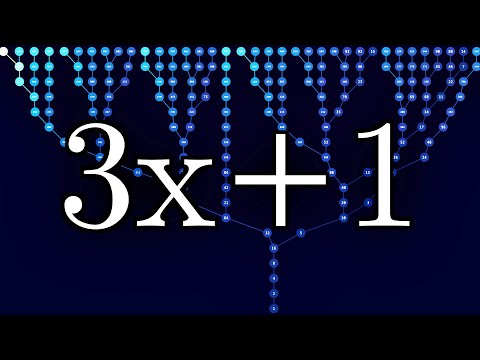
The Simplest Math Problem No One Can Solve - Collatz Conjecture #RwOT #Rwanda #Cristiano Ronaldo

The Simplest Math Problem No One Can Solve - Collatz Conjecture

💾

The Collatz Conjecture is the simplest math problem no one can solve — it is easy enough for almost anyone to understand but notoriously difficult to solve. This video is sponsored by Brilliant. The first 200 people to sign up via https://brilliant.org/veritasium get 20% off a yearly subscription. Special thanks to Prof. Alex Kontorovich for introducing us to this topic, filming the interview, and consulting on the script and earlier drafts of this video. ▀▀▀▀▀▀▀▀▀▀▀▀▀▀▀▀▀▀▀▀▀▀▀▀▀▀ References: Lagarias, J. C. (2006). The 3x+ 1 problem: An annotated bibliography, II (2000-2009). arXiv preprint math/0608208. — https://ve42.co/Lagarias2006 Lagarias, J. C. (2003). The 3x+ 1 problem: An annotated bibliography (1963–1999). The ultimate challenge: the 3x, 1, 267-341. — https://ve42.co/Lagarias2003 Tao, T (2020). The Notorious Collatz Conjecture — https://ve42.co/Tao2020 A. Kontorovich and Y. Sinai, Structure Theorem for (d,g,h)-Maps, Bulletin of the Brazilian Mathematical Society, New Series 33(2), 2002, pp. 213-224. A. Kontorovich and S. Miller Benford's Law, values of L-functions and the 3x+1 Problem, Acta Arithmetica 120 (2005), 269-297. A. Kontorovich and J. Lagarias Stochastic Models for the 3x + 1 and 5x + 1 Problems, in "The Ultimate Challenge: The 3x+1 Problem," AMS 2010. Tao, T. (2019). Almost all orbits of the Collatz map attain almost bounded values. arXiv preprint arXiv:1909.03562. — https://ve42.co/Tao2019 Conway, J. H. (1987). Fractran: A simple universal programming language for arithmetic. In Open problems in Communication and Computation (pp. 4-26). Springer, New York, NY. — https://ve42.co/Conway1987 ▀▀▀▀▀▀▀▀▀▀▀▀▀▀▀▀▀▀▀▀▀▀▀▀▀▀ Special thanks to Patreon supporters: Alvaro Naranjo, Burt Humburg, Blake Byers, Dumky, Mike Tung, Evgeny Skvortsov, Meekay, Ismail Öncü Usta, Paul Peijzel, Crated Comments, Anna, Mac Malkawi, Michael Schneider, Oleksii Leonov, Jim Osmun, Tyson McDowell, Ludovic Robillard, Jim buckmaster, fanime96, Juan Benet, Ruslan Khroma, Robert Blum, Richard Sundvall, Lee Redden, Vincent, Marinus Kuivenhoven, Alfred Wallace, Arjun Chakroborty, Joar Wandborg, Clayton Greenwell, Pindex, Michael Krugman, Cy 'kkm' K'Nelson, Sam Lutfi, Ron Neal ▀▀▀▀▀▀▀▀▀▀▀▀▀▀▀▀▀▀▀▀▀▀▀▀▀▀ Written by Derek Muller, Alex Kontorovich and Petr Lebedev Animation by Iván Tello, Jonny Hyman, Jesús Enrique Rascón and Mike Radjabov Filmed by Derek Muller and Emily Zhang Edited by Derek Muller SFX by Shaun Clifford Additional video supplied by Getty Images Produced by Derek Muller, Petr Lebedev and Emily Zhang 3d Coral by Vasilis Triantafyllou and Niklas Rosenstein — https://ve42.co/3DCoral Coral visualisation by Algoritmarte — https://ve42.co/Coral

Advertisement

LEAVE YOUR COMMENT

LATEST COMMENTS

@rowyerboat1 Says:
Gimme a sec….I can get ChatGPT to convince me I’m the math messiah and I solved this problem in 5 minutes.
@joeyvalentineofficial Says:
Hey @Veritasium, at 11:26 you said, "If you can show that every sequence contains a number less than the original seed, you have proven the conjecture." Are you sure that statement is true? Because that would make it trivial. All even-numbered seeds follow this rule, so that would mean the conjecture is true for all even numbers. If it's true for all evens, it's necessarily true for all odds, since starting with an odd seed must contain an even number in the sequence. If a sequence contains a number that obeys the conjecture, then the seed must obey the conjecture (which you can prove by induction). So I'm wondering, what is the basis for the statement you made at 11:26?
@tylerhoffman9856 Says:
This video sent me down a rabbit hole. I built a small program to test Collatz and a few nearby variations of the rule. Changing 3n+1 to 3n−1 produced a stable cycle (5 → 14 → 7 → 20 → 10 → 5). Other variants either exploded upward or collapsed toward zero. this doesn’t prove anything, and I’m sure mathematicians have explored these variations before. I just found it interesting Fun exercise either way.
@Baraa-u2q5h Says:
I know the video was before ai popularity but can modern ai help in this problem?
@Potatoman-r5t Says:
Chat I solved it so basically just do 3x-1 instead of 3x+1
@hurz506 Says:
It must be proven that for every starting number, you'll hit a power of 2. Have people been working on bit shifting?
@papastinky Says:
Has anyone asked Terrance Howard to take a crack at it!? 💀💀💀💀
@ReaINoobster Says:
The typa stuff i do on my calculator in math class:
@Ray_Ray_M Says:
Me going to AI to solve it. Be right back.
@pinklion63 Says:
Wouldn't the answer be undefined
@vectheric Says:
Cses - eird algorithm
@AJ_real Says:
That type of rule is proof that we just live in a simulation.
@its_prince4real Says:
How about we trace it backwards? 1,2,4,8,16 and then we start diverging as the next number could be 32 or just 5. Let's take 5, next will be 10 and we now dont know if next will be 20 or 3 same if we take 32, next will be 64 but we won't know if next is 128 or 21. I think there's some possibility of probability theory answering this...
@dengeleng7825 Says:
Why is it a Problem, what should it prove?
@Birch55 Says:
it's obvious, its a bomb algorithm for the timelords of dr. who
@ramilvaleriano8739 Says:
Hey @veritasium can have ur email i have theory to prove
@ralfflar7562 Says:
When going into negative numbers schouldn`t the Algorithm be adapted? Example 3x -1
@m1j9s79 Says:
I dont understand where the problem is?
@jeffrey-t5r Says:
I solved it, because it would always end up with a even number after 3x+1 and we all know that all even numbers can be divided by 2 so no matter how big the number is, it would always end up in 1 with enough steps
@johndomutz1052 Says:
Honestly, who cares? It means nothing.
@willtews955 Says:
Your question is does it actually need to be solved? There's just some kind of rule or law? I think it's about it could you be used to civil different teams from algorithms generators computation processing analyzing etc.
@dragonxswords114 Says:
Solved it. Rules are flawed. The divide by 2 on even number causes this. Because it means that ANY equation where X can equal 1, that hits a number divisible by by 2 will immediately hit this loop. For example, if you replace the first part with 7x+1. And this ruleset eventually hits a number divisible by 2 (which it eventually will). It will go down to 1. 1x7+1=8 8÷2=4 4÷2=2 2÷1=1 Repeats Other examples this works on: 3X+5 (because 3(1)+5=8 so 8 will be loop 15X+1 (because 15(1)+1=16 so 16 will be loop That being said, the higher numbers you use, the longer it will take for equation to hit breakpoint (divisible by 2) number. Your welcome
@schiacciatrollo Says:
nice game, what is it for?
@Janseenium Says:
This is a good video.
@Glitch_Eyes2 Says:
Me personally,im not here because i like maths. Im here because im tryna study for exams and continue studying the concept of space and blackholes but got interested by this.
@42ndMoose Says:
the answer has been solved by gpt and has highlighted by terence tao. this is the answer: Yes — for any 0 < C_1 < C_2, there are infinitely many a, b, n with b = n/2, a = n/2 + O(\log n), C_1 \log n < a + b - n < C_2 \log n, such that a! \, b! divides n! \, (a + b - n)! .
@autisticole Says:
easy, the answer is 28
@WhoEvenKnowsNow Says:
Has anyone tried working on it backwards?
@DerekCFPegritz Says:
This is about as pointless as trying to find order in the digits of pi. Some numbers are simply infinite.
@vtrandal Says:
No flat earth believer is worthy to hear the truth you speak. No, not one.
@Kokosnott72 Says:
10:14 - infinity is not a number, all numbers lead to one.
@Savory_Pancakes Says:
if there's inifinite numbers, wouldn't it just be infinity? why wouldn't there always be that one that goes even-odd-even-odd all the way? why wouldn't there be infinite loops in the way of that?
@AndyKuzmenko-e4d Says:
Easy. 3k + 1 = 4k
@imperablebz Says:
Anyway, it doesn't matter—I solved it, DM... but a mathematician will always ask, "What if there's an even bigger number?" Mathematicians are like children.
@Foxi16cz Says:
Im making a program that will check other numbers
@VoxelQuest88Gaming Says:
It's insane to me that you can explain the rules of this problem to a third grader, but the greatest mathematical minds in history still can't prove it. The Collatz Conjecture is the ultimate 'easy to learn, impossible to master' concept.
@VoxelQuest88Gaming Says:
Paul Erdős saying 'Mathematics is not yet ripe enough for such questions' is both the hardest and most terrifying quote in math history. If the guy who practically lived on numbers says we aren't ready, we definitely aren't ready.
@VoxelQuest88Gaming Says:
The fact that they've tested nearly 300 quintillion numbers and STILL haven't found a single exception or counter-loop is mind-boggling. 4-2-1 is simply inevitable!
@VoxelQuest88Gaming Says:
I love how Veritasium can take a math problem that makes geniuses give up, and turn it into 20 minutes of pure, edge-of-your-seat entertainment. Absolutely brilliant video!
@Petetornado Says:
My solution: The answer to 3x+1 depends on what number "x" equals. For example, if "x" were to equal 2, then 3x+1 would equal 7 because 3⋅2=6, and 6+1=7.
@GiftedG-y6y Says:
Well they can’t solve it because they never saw the gap
@januszkrechowiak1147 Says:
Interesting video, but it's a pity that plot of 3 loops within negative numbers wasn't explored more
@nathanielboddie9531 Says:
??? Literally no other number in existence could it end up being? You have to eventually end up at 1, no matter what number you begin with… how does anybody waste their time on this? That’s common sense math? Backtrack it and find another number that would loop first- and then prove me wrong…. 3x3+1 =10 /2 = 5*3=15+1=16 /2=8/2=4/2=2/2=1…. There is no rationale behind any of it- 1 is the only one that causes a loop small enough to recreate the loop
@MalWv4 Says:
Bro it’s 10 (edit wait nm Srry I was wrong)
@ericbitzer5247 Says:
4x?
@Landereer Says:
HOW DID HE GUESS I PICKED SEVEN?????
@Xyconical Says:
10:23 Maybe the loop can be other set of numbers like negative numbers
@Mohammad-r7d4n Says:
Pov: you think this is 3x + 1 from 7th grade math class and "solve" it in the comments😂
@ankitasingh5658 Says:
if you add 1 to x first, then the 4, 2, 1 loop becomes a 6, 2, 1 loop
@huntergolden7416 Says:
x = -1/3

More Science Videos