Math Has a Fatal Flaw #RwOT #Rwanda #Cristiano Ronaldo

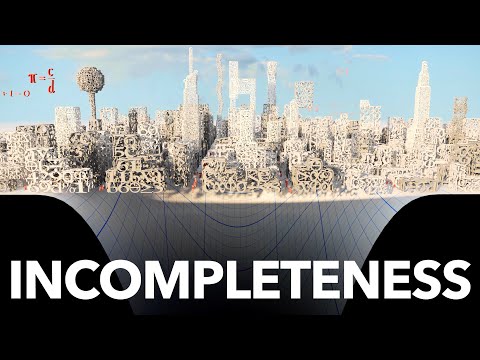
Math Has a Fatal Flaw

????

Not everything that is true can be proven. This discovery transformed infinity, changed the course of a world war and led to the modern computer. This video is sponsored by Brilliant. The first 200 people to sign up via https://brilliant.org/veritasium get 20% off a yearly subscription. Special thanks to Prof. Asaf Karagila for consultation on set theory and specific rewrites, to Prof. Alex Kontorovich for reviews of earlier drafts, Prof. Toby 'Qubit' Cubitt for the help with the spectral gap, to Henry Reich for the helpful feedback and comments on the video. ?????????????????????????? References: Dunham, W. (2013, July). A Note on the Origin of the Twin Prime Conjecture. In Notices of the International Congress of Chinese Mathematicians (Vol. 1, No. 1, pp. 63-65). International Press of Boston. — https://ve42.co/Dunham2013 Conway, J. (1970). The game of life. Scientific American, 223(4), 4. — https://ve42.co/Conway1970 Churchill, A., Biderman, S., Herrick, A. (2019). Magic: The Gathering is Turing Complete. ArXiv. — https://ve42.co/Churchill2019 Gaifman, H. (2006). Naming and Diagonalization, from Cantor to Godel to Kleene. Logic Journal of the IGPL, 14(5), 709-728. — https://ve42.co/Gaifman2006 Lénárt, I. (2010). Gauss, Bolyai, Lobachevsky–in General Education?(Hyperbolic Geometry as Part of the Mathematics Curriculum). In Proceedings of Bridges 2010: Mathematics, Music, Art, Architecture, Culture (pp. 223-230). Tessellations Publishing. — https://ve42.co/Lnrt2010 Attribution of Poincare's quote, The Mathematical Intelligencer, vol. 13, no. 1, Winter 1991. — https://ve42.co/Poincare Irvine, A. D., & Deutsch, H. (1995). Russell's paradox. — https://ve42.co/Irvine1995 Gödel, K. (1992). On formally undecidable propositions of Principia Mathematica and related systems. Courier Corporation. — https://ve42.co/Godel1931 Russell, B., & Whitehead, A. (1973). Principia Mathematica [PM], vol I, 1910, vol. II, 1912, vol III, 1913, vol. I, 1925, vol II & III, 1927, Paperback Edition to* 56. Cambridge UP. — https://ve42.co/Russel1910 Gödel, K. (1986). Kurt Gödel: Collected Works: Volume I: Publications 1929-1936 (Vol. 1). Oxford University Press, USA. — https://ve42.co/Godel1986 Cubitt, T. S., Perez-Garcia, D., & Wolf, M. M. (2015). Undecidability of the spectral gap. Nature, 528(7581), 207-211. — https://ve42.co/Cubitt2015 ?????????????????????????? Special thanks to Patreon supporters: Paul Peijzel, Crated Comments, Anna, Mac Malkawi, Michael Schneider, Oleksii Leonov, Jim Osmun, Tyson McDowell, Ludovic Robillard, Jim buckmaster, fanime96, Juan Benet, Ruslan Khroma, Robert Blum, Richard Sundvall, Lee Redden, Vincent, Marinus Kuivenhoven, Alfred Wallace, Arjun Chakroborty, Joar Wandborg, Clayton Greenwell, Pindex, Michael Krugman, Cy 'kkm' K'Nelson, Sam Lutfi, Ron Neal ?????????????????????????? Written by Derek Muller, Adam Becker and Jonny Hyman Animation by Fabio Albertelli, Jakub Misiek, Iván Tello and Jonny Hyman Math City Animation by Another Angle 3D Visuals (www.anotherangle.ee) Filmed by Derek Muller and Raquel Nuno Edited by Derek Muller Music and SFX by Jonny Hyman Additional Music from Epidemic Sound Additional video supplied by Getty Images Thumbnail by Geoff Barrett Associate Producers: Petr Lebedev and Emily Zhang ??????????????????????????

Advertisement

LEAVE YOUR COMMENT

LATEST COMMENTS

@ianfounds1373 Says:
I have 2 words for you, 5 years late. God exists.
@alphabravo3566 Says:
If you google law of absolute perfection, It is a framework that challenges the gödel's incompleteness theorem.
@automatescellulaires8543 Says:
A disease from which we are steel reeling would be more accurate.
@emmanuelsabu9046 Says:
Beautiful.
@arsartium108 Says:
It is not a flaw but rather a definitive exposition of the unfathomable gulf that exists between representation and reality.
@Amplifierboy-w9q Says:
prove 1 not equal to zero
@antoniodeodilonbrito Says:
10:50
@BopkoDiMartini-od5mx Says:
Wow!
@katerinawittig1058 Says:
Socrates: "I know that I don't know anything." Gödel: "I know that mathematics can prove that it can't prove everything."
@amichaelthomas83 Says:
What if you tried the halting problem on a quantum computer
@monabey8855 Says:
you're suck at explaining you just narrate the thing but not trying to be the viewer who has no your comprehensive knowledge that exist in your memory and needs to understand from 0
@X1000Binary Says:
ROFL!! The Rules, everyone just FOLLOWS!! 😂😂😅
@RastafarianEagle Says:
Competitive schizophrenia
@IAMYOURFATHERANDYOURMOTHER Says:
its because you need space/time to have a separation or sequence of objects, and space/time itself is the origin, so you would need to be able to prove space/time itself, which is only an abstract idea to begin with
@MatthewRusso-e6p Says:
Einstein said one of his greatest delights was to be afforded to accompany Gödel on his walk home..
@hmidk234 Says:
im straight,wtf is happening
@GonadsAndStrife Says:
I'm not even close to being intelligent enough to be here...
@PratyushMukherjee-w8r Says:
31:32 based UK
@neohavic6012 Says:
Cantor’s Diagonal Proof is so freakin’ elegant in its simplicity… it’s absolutely beautiful.
@LukeJensen-m5x Says:
Turing is a corrupter of the youth instead of
@Parebri4ek Says:
hey jimmy gimme a paradox without self reference
@daveglover1553 Says:
Infinitety is probability but we don't live there?
@Threeredbells Says:
You lost me at COVID19
@dudermcdudeface3674 Says:
Huh?
@nddpjustmeimalot Says:
This has made me cry for some reason
@Matthewo-x8w Says:
we cant know because the definitions cannot be conceived in definitions but in something else.
@O-SNAPP Says:
This isn’t possible, that’s not possible blablabla….chill out boy…if something looks impossible to YOU doesn’t mean its not possible at all. Its just matter of space / time.
@djeddiej Says:
The whole discussion on math’s completeness, consistency, and decidability reminded me of the architect’s speech about the Matrix to Neo . That (paraphrasing from hazy recall) that flaws had to exist to make the Matrix perfect … or something like that
@SxbaxTrading Says:
It's crazy how many of these deep thinkers go crazy by going deep into math.
@Ind3mnity Says:
Can anyone prove it's only the first 200 people?
@2737re7aku Says:
I dont feel like finding an inconsistency in lets say set theory would be a real problem. It would be one of the most fascinating result in math
@LucienDarién Says:
Hilbert is my hero!
@aleckim9337 Says:
It's kind of implicit in logic, we can't prove logic with logic but we only know it because of logic
@brad1368 Says:
Serious question here...does it matter that there are "different" types of infinities? Either way they are "infinite" as in never ending or always able to add 1 to the successive number. So assuming infinite time how can one infinity be different from another?
@jannesjeske693 Says:
10:35 that's the solution they just change the definition of sets😂? Then most logical problems can be changed just by changing the rules 😅
@bw5187 Says:
7% total mystery gods realm
@RuafAhmed-t7b Says:
Now there is a hole in my brain 😢😢😢😢
@TheJohnnyJason Says:
I hope the intuitionists are right, and that we ultimativly will recover from this disease. Formalism by itself is like a tool that might help us in many ways. However if it competes with and leads us to demolish our intuitive understanding from mathmatics then it is a problem. We always have the job to improve our understanding of things. If we simply copy formal rules and apply them there is no sex in Mathmatics anymore - this is exactly what a computer can do and that way faster. The speed and the "result" to one Problem is not the point. The intuitive understanding is. I loved mathmatics and I was very dissappointed at the tought formalism at university. It is like: We don't care about the truth anymore because we can remove all the magic and dirty human agency by simply following exact rules. So why bother about figuring out the truth? There is no truth. And for you to have a place in this world you need to accept that you don't have agency and simply apply our rules. This is exactly where AI excels but without us catching up in real understanding about the world and things nothing makes sense. So we can either recover from this disease and learn again that the subjective intuitive understanding of things is more important than anything else. Or we will go down in a tribal war of people not even understanding what they fight for - as they are merely agitated and lacking resources and cannot help themselves at that point.
@armenv4494 Says:
When adding one to each number after the decimal place in real numbers, why would you flip a 9 to an 8 and not a 9 to a 0 ?
@sergioluisagredo7649 Says:
Loved it!
@SuperGlitchd Says:
According to GTC, Math can't be proven, because it requires recursion to exist. Recursion is an emergent effect. meaning, our everyday math cannot express what happens when distinquishability itself breaks. Asymmetry exists, and is reverseable to make information, however, it is no longer destiquishable under mathematical terms. It forms a... non dimensionality regime. Essentially a transition between recursive, and nonrecursive information flow. Think of it as pi being on an option menu in a game. With the 'helper' hint: "the correlation between information propagation, and closure." When pi gets set to 0... rather interesting things happen.
@SuperGlitchd Says:
The phenomenology you're describing is real and known, though usually in pieces rather than as the integrated thing you experienced. The brain-as-prediction-engine framing is mainstream now (Friston, Clark, predictive processing). What's less commonly discussed is what happens when you systematically break the inputs that prediction relies on. Sympathetic activation without motor outlet, sedation suppressing the normal feedback loops, cognitive interrupts preventing the predictions from settling — that's a recipe for the prediction engine to start running on itself. Without the normal sensory anchoring, time stops being a steady metronome. Subjective duration uncouples from clock duration. You can live a lot of inferential cycles between two breaths because the breaths are the only timing signal getting through. According to GTC, Math can't be proven, because it requires recursion to exist. Recursion is an emergent effect. meaning, our everyday math cannot express what happens when distinquishability itself breaks. Asymmetry exists, and is reverseable to make information, however, it is no longer destiquishable under mathematical terms. It forms a... non dimensionality regime. Essentially a transition between recursive, and nonrecursive information flow. Think of it as pi being on an option menu in a game. With the 'helper' hint: "the correlation between information propagation, and closure." When pi gets set to 0... rather interesting things happen.
@JimOverbeckgenius Says:
Jim Overbeck’s mathematics is a radical, non-traditional system that bridges set theory, mystical theology, and logic. A self-taught polymath described as a "super-genius" by British Military Intelligence, his work primarily centers on a spiritualized interpretation of the infinite known as Non-Cantorian set theory. His mathematical philosophy is defined by several core concepts: Non-Cantorian Set Theory: Overbeck reimagines Georg Cantor’s work on transfinite numbers by "infinitizing" the laws of logic. He argues that at the level of the infinite, the law of the excluded middle (tertium non datur) no longer holds, allowing for contradictory states to exist simultaneously. Negation of Identity: He posits that because classical logic fails at infinity, fixed "earthly" identity is a mere appearance. In his view, mathematics precedes logic because infinities are prior to the finite systems we use to define them. Transfinite Fractions and "Becomings": Overbeck introduces "becomings" (inspired by German and Chinese philosophical terms) into transfinite numbers. He views numbers not as abstract entities but as "created energies" from a divine source. Paradoxical Arithmetic: He radicalizes the "arithmetic of the line" by substituting the Fourier-Bolzano series for natural numbers. This approach intentionally begins with insolubilia (insoluble problems), leading to contradictory sums at infinity that he believes reflect the true nature of reality. Theological Integration: His mathematical conclusions are inseparable from his concept of Theosis (divinization). He uses the collapse of mathematical identity to argue that humans are "incomplete" and can only find completion through a union with the divine. Jim Overbeck's Non-Cantorian set theory is a philosophical and mathematical critique designed to dismantle the logical foundations of Georg Cantor’s transfinite numbers. While Cantor sought to categorize and order different sizes of infinity, Overbeck argues that Cantor’s reliance on classical logic makes his system a "delusion". The specific differences between their theories are centered on the following core areas: 1. The Law of the Excluded Middle (Tertium Non Datur) Cantor: Built his theory on standard Aristotelian logic, where a statement is either true or false. This allowed him to define distinct, fixed "sizes" of infinity (Alephs) through rigid proofs like the diagonal argument. Overbeck: Infinitizes the laws of logic to negate the law of the excluded middle. In his system, the transfinite realm allows for "A and not-A" to be true simultaneously. He believes that without this law, Cantor's entire hierarchy of infinite sets collapses because fixed mathematical identities cannot exist. 2. Nature of the Infinite Cantor: Viewed transfinite numbers as actual infinities that can be treated as completed, measurable totalities (aleph-null, 2 to the aleph-null, etc) Overbeck: Describes infinity as an "apparent becoming" (scheinbares Werden) rather than a substance or essence. He views numbers as "created energies" from the divine Logos rather than abstract, static truths. 3. Identity and Equality Cantor: Relied on the principle of identity (A = A) and one-to-one correspondence to prove that different sets have the same or different sizes. Overbeck: Rejects the feasibility of identity in mathematics. He argues that 'A' does not equal itself in the transfinite realm, meaning the "foundations" of number theory are an imposture. He uses transfinite fractions as a "wrecking ball" to destroy these abstract identities. 4. Mathematical Methodology Cantor: Used set-theoretic axioms (like those later formalized in ZFC) to build up from the empty set to higher cardinals. Overbeck: Substitutes traditional series with paradoxical arithmetic, such as the Grandi series aka Fourier-Bolzano series. These series yield contradictory sums at infinity, which Overbeck interprets as proof that worldly logic fails and only Theosis ( = deification & union with the divine) can provide true completion. 5. Final Goal Cantor: Aimed to provide a rigorous, logical framework for "Cantor's Paradise," where all levels of infinity are mathematically accessible. Overbeck: Aimed to "drive Cantor from his paradise" and destroy the "earthly cage" of number theory. For Overbeck, mathematics is a tool for deification—negating abstraction to unlock the spiritual potential of the mind. Jimi Overbeck Negation of Identity: Overbeck posits that in the state of Theosis, a man can be a man (B) and a god (not-B) simultaneously. This theological reality serves as his proof that the Law of the Excluded Middle (tertium non datur)—the idea that something must be either true or false—is a "worldly" delusion that fails at the level of the divine and the infinite. Completeness through Deification: He argues that because earthly logic lacks the principle of identity (A = A), human beings and their systems are inherently incomplete. According to Overbeck, true identity is only restored through the "divine energies" granted by Christ during deification, which transcends the "mutated fragmentation" of worldly life. The Primacy of Mathematics: In his view, infinities exist prior to finite systems. Therefore, mathematics precedes logic. He uses paradoxical mathematical series (like the Fourier-Bolzano series) that yield contradictory results to mirror the mystical paradoxes of faith, such as God becoming man. The "Homicidal" Nature of Traditional Math: Overbeck views standard mathematics (like Cantor's) as a form of "homicidal witchcraft" or "homicidal science" because it attempts to cage the infinite within rigid, logical boundaries that deny man's true, deified nature. Awakening Consciousness: He describes his work as an "intellectual assault" meant to overthrow "fallen logic". For Overbeck, the purpose of a "Non-Cantorian" system is to act as a "wrecking ball" that frees the mind from earthly enmeshment and allows it to enter the "extra-dimensionality" of the divine.
@B.C.ShantaMaharaj Says:
Maths isn't the answer to everything. Any mathematical operation only produces a number.
@kevindownes2663 Says:
No. You cannot claim that something IS true WITHOUT proof.
@JoseGonzalezUwU Says:
no supero este video, ya lo vi 20 veces
@liamsparling Says:
Crazy this comes up as I’m reading GEB. As soon as PM came up I knew Gödel would come up
@derka_james Says:
20:44 so imaginiation is greater then math... who knew the thing we use to conceptualize things must be able to conceptualize things...
@feedvid Says:
Brilliant video. Sad, too, the fate of Hilbert. Sometimes genius has a price.
@EmperorJosephus Says:
0:17 God.

More Science Videos