Raspberry Pi Pico LCD Projects

Raspberry Pi Pico LCD Projects

????

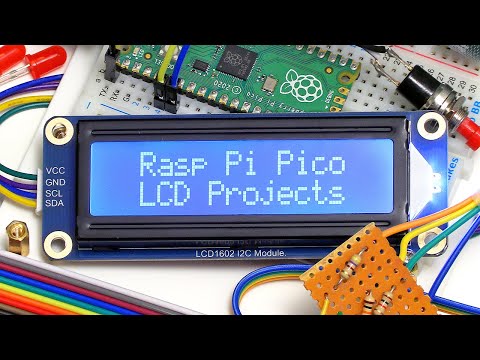
Connecting a low-cost LCD module to a Raspberry Pi Pico, and checking out some project applications. All code and wiring diagrams can be accessed at https://explainingcomputers.com/pi_pico_lcd.html My previous Pi Pico Input & Servo Control video is here: https://www.youtube.com/watch?v=TDj2kcSA-68 And my Raspberry Pi Anemometer video is here: https://www.youtube.com/watch?v=1LPEPZ02-t8 At the time of uploading this video, the Waveshare LCD module I used in the video was available from: The Pi Hut: https://thepihut.com/products/lcd1602-i2c-module Amazon US: https://amzn.to/3HcOooR Amazon UK: https://amzn.to/43VqGXQ Note the above Amazon links are affiliate, and that I earn a commission from any qualifying purchases you may make. The Waveshare LCD 1602 I2C module support page is here: https://www.waveshare.com/wiki/LCD1602_I2C_Module And you can directly download the drivers and test files here: https://www.waveshare.com/w/upload/d/db/LCD1602_I2C_Module_code.zip The 'Reflective IR Sensor' used in the anemometer is available from vendors including Pimoroni: https://shop.pimoroni.com/products/reflective-ir-sensor-with-470-and-10k-resistors and from Adafruit: https://www.adafruit.com/product/2349 (NOT affiliate). For additional ExplainingComputers videos and other content, you can become a channel member here: https://www.youtube.com/channel/UCbiGcwDWZjz05njNPrJU7jA/join More videos on computing and related topics can be found at: http://www.youtube.com/@explainingcomputers You may also like my ExplainingTheFuture channel at: http://www.youtube.com/@explainingthefuture Chapters: 00:00 Introduction 01:03 LCD I2C (unboxing) 03:44 MicroPython Control 07:15 Does it Game? 12:46 Measuring the Wind (anemometer) 16:33 Wrap #Pico #LCD #RaspberryPi #explainingcomputers

Advertisement

LEAVE YOUR COMMENT

LATEST COMMENTS

@Chimp_No_1 Says:
I’m new to Raspberry Pi and really appreciate your videos. 🥳
@sinchicken00 Says:
I became very excited when I saw "DOOM" in the code. Then you proceed to play the most exciting game in the world. 😂
@apenguinnamedabraham Says:
I'm learning this stuff for the first time as a 27 year old and it feels like everyone describes these projects for people who already know what they're doing. Thank you for explaining everything so clearly!
@alexneudatchin Says:
but to wait 0.1s on check_button_state is just newbiesh stuff didn't you know. 0.05s lag . you have cpu not for this. google 'raspberrypi stackexchange questions 44416' . also 'Button causes high cpu usage 1007'
@p0kepengin592 Says:
is there a version of the firmware that works with circuitpython?
@kairysisKrantas Says:
Why these LCDs are so bulky? OLEDs and E-ink are much thiner. I would use these LCDs because you can turn off backlight and still operate so much more energy efficient.
@SourojitBh Says:
Very exciting indeed!
@garyplewa9277 Says:
Thank you for making this video. I purchased one of these Waveshare LCD displays and could not get it working as the many other online examples were for different devices and were confusing at best. You sir, explain things clearly without any unnecessary drama.
@tomcaton8932 Says:
How do I adjust the text brightness and background so I can read it?
@alexmcd378 Says:
Have you seen The 8-Bit Guy's video on LCDs? He covers the older standard instead of I2C, builds a box of switches for hand encoding the text, and also drives one using a Commodore 64 user port as gpio. Great stuff
@Sawyer-W-C Says:
thonny gives me a error: Traceback (most recent call last): File "", line 4, in File "LCD1602.py", line 56, in __init__ File "LCD1602.py", line 98, in begin File "LCD1602.py", line 60, in command OSError: [Errno 5] EIO
@geoffstone356 Says:
Superb channel with great instructions and videos. I have a question please, how easy would it be to adapt these projects for a arduino nano instead of the raspberry pi pico? the reason being I have several spare arduino nanos and no raspberry pi picos :-)
@Rushil69420 Says:
I just impulse bought another Pico W at Micro Center *yesterday* and happened to find an 1602 lcd module from an old Arduino starter kit kicking around last week - this video could not have come at a better time!
@Szwagier-SP6IOT Says:
7:36 - Shouldn't the GP0 be pulled down do the GND with pull-down resistor?
@MorrWorm8 Says:
How do you find a list of things you can import in code, ie import machine, time etc? Is there a place to see that say on a pi or a website? Sorry total noob
@retrobombstudios1258 Says:
Great vids.Im having problems here though and everything is wired and installed correctly. MPY: soft reboot Traceback (most recent call last): File "", line 4, in File "LCD1602.py", line 56, in __init__ File "LCD1602.py", line 98, in begin File "LCD1602.py", line 60, in command OSError: [Errno 5] EIO
@rastan1977 Says:
I really like your videos.your very old English and have a way about you that inspires me to drink tea and learn. I have a feeling I will be my teacher. Just remember to respond to msgs to the best of your ability and refrain from becoming a YouTube hero
@tonywalker2372 Says:
Brilliant! Thankyou.
@Coding_Monkey887 Says:
Hey, would you be able to do a video on the rp02040 watch developer board I can’t find any documentation on it, and I love how you explain computers very easily specially the raspberry pi.
@paterpracticus Says:
Incredibly helpful. Thank you.
@MikeJohansen-k3c Says:
What happens if the text goes out of bounds, does it scroll?
@brucehanson4147 Says:
Thank you Chris, been looking for a simple, economical way to display measured parameters or what step of a program was in on a PICO. Just an update on the display you used, the current version from them uses a RGB LED back light so you can make it any color you wish...but you do have to add code for that too.
@RixtronixLAB Says:
Nice video, well done, thanks for sharing it with us :)
@TerraMagnus Says:
I enjoy watching your videos. I’m most interested in the SBC reviews. It would be really interesting to see cool projects with these boards, perhaps as a series. It would be really neat to partner with other channels that are way outside your wheelhouse. So like how about using an SBC as a controller board for a vintage motorbike project with a channel that builds bikes? Using an SBC to control a very novel set of lights for the bike to keep it safe and visible on the roadways. You mentioned maybe looking at ESP32. You could make content for months easily just scratching the surface with how these things are used. Especially if you start seeing it through with home automation use cases.
@philsbbs Says:
Can you recommend a larger screen that could be used..
@rickhunt3183 Says:
Sorry about coming late to the party. I think it's best not to use a breadboard when you can get away with it. A breadboard adds a perceived layer of complexity for some people, and having direct connections like you have demonstrates how simple this really is. The whole point being, is to motivate people and stimulate people to use their imagination to build a project. The biggest obstacle people have is telling themselves that something is too hard or takes too much time. You make your presentations look simple. Perhaps it would be informative if people knew exactly how much thought and preparation you require to put together a 20 minute video and just how much work this really is. Most people don't recognize you're following an algorithm as though you were writing a paper. I can see and appreciate the work you put into your videos. In closing, just take care of yourself and eat healthy.
@fram1111 Says:
Good lungs on you not to mention your brain housing group appears to be working exceptionally well. Love how you leave the projects open so others will need to use their creativity to finish a project. Plus the vast amount of recourses you provide us. Until next time keep your gears spinning. Thank you.
@championslayers Says:
I love little projects like these. I typically use 1 inch oled i2c displays for my projects. I can typically find them for less than $2 or $3 each.
@elektron2kim666 Says:
I really like the Pico for a simple task. Maybe I find some focus for my displays and ideas. It's like I'm building the environment at least. I tried a few projects and I'm missing a number or a text showing that doesn't come via a Raspberry Pi 3.
@TooSlowTube Says:
Is the Python I2C implementation blocking, or non-blocking? The nature of I2C is that you have to send a byte, then wait a short amount of time before you can send the next one. If you make the CPU actually wait, that's "blocking", because nothing else can be done in the meantime. A non-blocking system would have to use another process, perhaps interrupt driven, implementing a queue of bytes to be sent. That then doesn't have to block unless the queue is full, or not even then if the main program can check if it is, and decide not to send anything else, so it can get on with other things. Generally, SPI is easier because it can be so fast that a CPU doesn't need to wait long, so it it can use a blocking strategy without slowing down noticeably.
@Xenon777_ Says:
Could be used for a desktop RSS feed reader
@skyballs-archive Says:
Upgrade your Picroft(just like your previous video )with display so i can see what mycroft saying and also add a time and date
@drummindog Says:
Chris, you need to submit that game design to Steam and make some money. I can see it rivaling Call of Duty as far as fun goes. ;) Thank you for your videos, Chris.
@mikefinn2101 Says:
should have said great fun too. made a keyboard mistake typing too fast. sorry Peter
@mikefinn2101 Says:
Nice change in menu and nice to add a LCD screen for a change i like it. Love how you easily teach us students. it is fun Peter you are just KIND and Amazing so great full to you
@billloveless6869 Says:
Is there a set of software set you would recommend for testing/benchmarking a Raspberry Pi? Thanks
@trevorbartram5473 Says:
I have an application that has not been solved by any commercial device. Sony Blu-ray players do not have a front panel display. When used as an CD transport and NOT connected to a TV there is no way to set up the player or see track info. I need an HDMI to WiFi adapter to display the info (480p widescreen would be fine) on a Fire tablet (also used for music streaming control). Has there been a Rasp Pi project for such a HDMI to WiFi adapter? What Fire tablet software is required? I don't have Rasp Pi experience but do have microprocessor & PC experience. Thanks in advance!
@maxpolaris99 Says:
The brass screw and putty esthetic on the anemometer just blew my socks off.👍
@WalterMan Says:
I use a pi pico with an oled screen connected to my pc with a custom app I coded to display temperature and cpu usage.
@fjl05 Says:
'I' squared 'C'? I always been calling it 'I' two 'C'
@cptPflaume Says:
very nice, thanks
@justabit-02 Says:
Raspberry Pi Pico is amazing. So much easier to work with than aurdino while being much more competent.
@marklucas8110 Says:
Chris, you just need a sensor to measure moss density and get a pi controlled rover called 'Rolling Stone' to sort it out 😉 Great video as usual!
@joeg3950 Says:
Thank you for the video. I may have a few ideas for this type of project. Maybe a weather station, or remote screen for heating system alerts… Cheers!
@lauriesherlock4841 Says:
@temyraverdana6421 Says:
A wonderful video. Thanks a lot
@boner2008 Says:
1 cuppatea, 2 cuppatea, 3 cuppatea, 4 cuppatea, 5 cuppatea... 10 cuppateeeeaaaa
@ronaldmarshall5845 Says:
Great Video Chris! I think I will make one of those with my Grand Daugther! Would Love to see the screen used with a pi zero, pi 3, or pi 4!
@shellz831 Says:
Can you do a video on installing Coreboot and PFsense on Pi4?
@jaffarbh Says:
The Pico is a natural twin to this display and can be used together in many real-world applications. Thank for sharing the base code Chris. Will make our lives easier when experimenting.

More Programing Videos